Léo Dubois has been the first choice right-back or right-wing-back at Lyon since his arrival on a free transfer from Nantes in summer 2018. He’s an accomplished all-rounder, as good going forward as he is defensively, and has been one of the club’s most consistent performers over the past two seasons.
His crossing ability from the right flank creates frequent goal scoring chances in the opposition box and he’s not afraid to take on defenders himself and carve out shooting opportunities, chipping in with the occasional goal. He’s solid and tactically astute when required to defend and rarely gets beaten in one-on-one situations.
His performances in his first season at Lyon saw him called up to the French squad for a post season friendly against Bolivia, in which he made his debut as a half-time replacement for Benjamin Pavard and he has been a regular member of the squad since then, accruing five caps to his name.
Dubois began his career with Nantes, coming through the youth ranks to make his debut at the end of the 2014-15 season aged twenty. He made 24 league appearances the following season as Nantes finished 14th in Ligue 1 and was a regular from the 2016-17 campaign onwards as the Canaries finished 7th and then 9th in Ligue 1 before his move to Lyon.
He has occasionally been linked with a move away from Lyon, with PSG rumoured to be interested, but will remain at the club for the 2020-21 season as two other right-backs (Rafael and Kenny Tete) have already been sold during the summer transfer window, leaving Lyon short on cover for that position.
Date of Birth: 14/09/1994 Place of Birth: Segré Nationality: French Joined OL: 01/07/2018
Dubois left Lyon in July 2022, signing for Galatasaray in Turkey for £2.25 million. He made twenty Ligue 1 starts for Lyon in an injury disrupted final season at the club and the emergence of Malo Gusto in his position meant that Lyon were happy to listen to offers for Dubois.
Maxence Caqueret is yet another prodigious talent to come off the fertile Olympique Lyonnais production line. The French central midfielder is a local boy, who has been on the books of the club since the age of eleven and now looks set for a long career at the top level.
He progressed steadily through the ranks at Lyon before making his first team debut in a Coupe de France game away at FC Bourges in January 2019. He again featured briefly as a substitute in the next round versus Caen the following month before returning to the reserves for the remainder of the season.
2019-20 was to be his breakthrough season. He began the campaign with the reserves in the National 2 division before permanently joining the first team squad and making his first Ligue 1 appearance on the 30th of November in a 2-1 win away at Strasbourg. From that point on he never looked back, quickly cementing his place as a mainstay of the midfield and playing with a maturity beyond his tender years.
He ended the season playing in a Champions League semi-final against Bayern Munich, having been part of the team that knocked out Manchester City and Juventus as the competition resumed after the Covid-19 interruption. He also put in a fine performance in the Coupe de la Ligue final against Paris-Saint Germain and scored a penalty in the ultimately unsuccessful shoot-out after a goalless draw.
Recognised as a bright talent from a young age, Caqueret has been involved in the national team setup at every age group level since captaining the Under 16s, notching up almost 60 appearance in youth internationals. He has been to the UEFA U17, U19 and U21 Championships and the U17 World Cup and it’s surely only a matter of time until he receives his first call-up to the full France squad.
Caqueret is a versatile midfielder with the ability to play a defensive holding role snuffing out opposition attacks and shielding the defence or a more roving box-to-box role. He’s already tactically disciplined, positionally aware and intelligent on the ball. He reads the game well and is often perfectly placed to make a crucial tackle or interception.
He’s able to cover a lot of ground during a game and is capable of scoring the occasional goal, although that’s not one of the main strings to his bow. Technically he’s one of the most proficient players at the club, with near perfect mastery of the ball and flashes of skill that have seen him wriggle out of some seemingly impossible positions with the ball still under his spell.
His slicked back black hair and gaunt appearance make him look not unlike a young Stanley Matthews and, whilst not matching the Englishman in playing style, he does have a fleetness of foot to compare with the “wizard of the dribble”. Hopefully Lyon can hang on to him for a long time to come and build the team around him as they look to return to the glory years of the early twenty-first century.
Date of Birth: 15/02/2000 Place of Birth: Vénissieux Nationality: French Joined OL: 2011
Previous teams: FC Corbas (2006-07) FC Chaponnay-Marennes (2007-11)
German goalkeeper Julian Pollersbeck joined Olympique Lyonnais in September 2020 as cover for Anthony Lopes, on a four year contract for an initial fee of €250,000 from Hamburg. He takes over the reserve goalkeeper role from Anthony Racioppi, who left Lyon to join Dijon the same week.
Pollersbeck took his place on the Lyon bench for the first time in the 1-1 draw away at Lorient on the 29th of September and will hope to get first team opportunities in the Coupe de France later this season. Otherwise, he’ll be very much a reserve unless Lopes gets injured, suspended or suffers a loss of form.
He’s no stranger to the role of reserve, having been demoted to third choice ‘keeper at Hamburg for much of last season. He suffered an ankle ligament injury during winter training, but did recover in time to regain his place in the starting XI for the final six games when German football resumed after the Covid-19 suspension.
However, he was unable to help Hamburg to promotion, and his final appearance for the club was an embarrassing 5-1 home defeat to Sandhausen as they missed out on the play-offs on the last day of the season.
Most of his first team experience to date is in the 2. Bundesliga. He was most recently first choice for Hamburg in the 2018-19 season during their first failed promotion campaign. His only taste of top-flight action came in the second half of the previous season when he featured regularly as HSV slumped to their first ever relegation.
Prior to that, Pollersbeck had also been first choice at Kaiserslautern for a season in the 2. Bundesliga in 2016-17, following a couple of year’s in the club’s reserve team. It was his form during that final season at Kaiserslautern that prompted Hamburg to pay €3.5 million for him in summer 2017.
Pollersbeck was born in Bavaria and began his career with local club Wacker Burghausen before joining Kaiserslautern shortly before his nineteenth birthday. He has represented Germany at youth level and won the European Under-21 Championships in Poland with them in 2017, when he was also named in the team of the tournament.
He kept a clean sheet in the final of that tournament, a 1-0 win against Spain, and saved Nathan Redmond’s penalty in the semi-final shoot-out against England to seal Germany’s spot in the final. Since then his career hasn’t quite lived up to its early promise but, at 26, there’s plenty of time left for him to re-establish himself as a number one should he get the opportunity.
Date of Birth: 16/08/1994 Place of Birth: Altötting Nationality: German Joined OL: 18/09/2020
Lyon plucked Tino Kadewere from Ligue 2 outfit Le Havre in January 2020 in a transfer deal worth up to €15 million. He was seen primarily as an exciting prospect for the future and was therefore loaned back to the Normandy based club for the remainder of the season.
At twenty-four, the Zimbabwean international striker will be something of a late developer if he does go on to make a big impact at OL, having never previously played at the top level in one of Europe’s major leagues. However, his career trajectory has been steadily on the rise and he still has some time on his side. He may well benefit from coming into the squad at a time when his fellow Lyon strikers are all struggling for goals in the early part of the 2020-21 season.
Kadewere was born in the Zimbabwean capital Harare and began his career with local club Harare City. He had only made a few appearances for them before he went to try his luck in Europe and joined Swedish top division club Djurgården, initially on loan and then permanently following a successful trial.
He made his debut for the Zimbabwe national team as a nineteen-year-old in 2015 shortly before he arrived in Sweden, but he was used sparingly, and often as a substitute during his first couple of years at Djurgården before making his breakthrough in the 2018 season with eight goals in twelve league appearances and winning the Swedish Cup.
June 2018 saw Kadewere travel to South Africa to contest the COSAFA Cup with his national team and he played a major role in the final against Zambia, scoring twice, including a crucial injury time equaliser, as Zimbabwe went on to lift the trophy. Those remain his only two international goals to date.
That form prompted Le Havre to pay €2 million for his services and he made 23 appearances in Ligue 2 in the 2018-19 season but clearly took time to adapt to his new surroundings, finding the net only five times during the campaign. The following season was a different story, with Kadewere going from strength to strength as he plundered 20 goals in just 24 games to finish as the division’s top scorer.
Lyon clearly believe that he will be able to make the step up to a higher level and he’s likely to get some opportunities to do so during the coming season as Lyon have off-loaded the likes of Martin Terrier and Bertrand Traore to move Kadewere further up the pecking order of their attacking options.
Date of Birth: 05/01/1996 Place of Birth: Harare Nationality: Zimbabwe Joined OL: 22/01/2020
Previous teams: Harare City (2014-15) Djurgården (2015-18) Le Havre (2018-20)
Karl Toko Ekambi is a Cameroonian international striker who can operate as a conventional centre-forward or cutting in from a wide position on either side of the attack. He has a strong physical presence, poses an aerial threat inside the box and is useful at holding the ball up to bring his team mates into the game.
He initially joined Lyon on loan from Spanish club Villareal in January 2020 to bolster the front line in the wake of Memphis Depay’s cruciate ligament injury, and he impressed enough for the Lyon management to make the move permanent at the end of the season for a fee of €11.5 million on a four year contract.
He hadn’t exactly been prolific during his first few months in Lyon, finding the net only twice, but his all-round game offered something a bit different to Lyon’s other attacking options, so he proved a useful addition to their squad.
His work rate off the ball far exceeds that of Moussa Dembele or Bertrand Traore and he’s much better than them at retaining possession, so he was invaluable during Lyon’s run to the Champions League semi-finals where he became a vital outlet to relieve pressure against stronger opposition.
Ever the willing runner, if Toko Ekambi can rediscover his killer instinct in front of goal then he will become one of the club’s most valuable assets. Having recently turned 28, he should be in his prime and ready to prove his worth for his new club.
Toko Ekambi was born and raised in Paris and began his career with Paris FC in the National division. His third full season at the club, 2013-14, proved to be his breakthrough season. He found the net 14 times to finish second top scorer and earn his first transfer, stepping up a division to Sochaux in Ligue 2.
His two seasons at Sochaux produced more double-figure goal returns and a first call up to the Cameroon squad. His performances started to attract the attention of Ligue 1 clubs and it was Angers who moved for him in summer 2016, shortly before he scored the first of his three international goals to date, in a 2-0 win for Cameroon against Gambia.
Toko Ekambi’s first season at Angers brought him ten goals (all competitions) and a Coupe de France final appearance against Paris Saint-Germain at the Stade de France, which was lost 1-0 in injury time. He also won the African Cup of Nations in February 2017 with Cameroon, although he didn’t feature in the final.
His second season was his most prolific thus far, his 17 goals making him the ninth top scorer in Ligue 1 and earning him a big money move to Villareal for around €20 million in summer 2018. He carried on in Spain where he had left off in France, registering 18 goals in all competitions in his first season there and had racked up a further six in 2019-20 before Lyon made their move for him.
Date of Birth: 14/09/1992 Place of Birth: Paris Nationality: Cameroon Joined OL: 20/01/2020
Previous teams: Paris FC (2010-14) Sochaux (2014-16) Angers (2016-18) Villareal (2018-20)
The range of alcohol-free beers has expanded rapidly over the last few years and most of the major players in the brewing industry now have their own non-alcoholic offerings. Long gone are the days when Kaliber was the only player in the field.
The quality of these products had also improved dramatically, with some of them now almost indistinguishable in taste from their alcoholic counterparts. Teetotal beer enthusiasts have never had it so good.
Personally I’ve moved over to drinking more and more of them since having children made the prospect of a hangover even less desirable, and never knowing when you might suddenly need to run one of them into A&E makes being over the drink-driving limit impractical.
As somebody who is striving to keep fit and keep the weight off in middle age, it’s an added bonus that many non-alcoholic beers also count as fairly healthy, low-calorie drinks, especially compared to some of the sugary alternatives usually available to to non-drinkers in pubs and bars. And it’s much easier to actually get out of bed and exercise in the morning if you haven’t been drinking the night before.
Here’s a ranking of some of my favourites amongst the brands widely available in UK shops.
I’ve always had a fondness for wheat beers and Hoegaarden has been one of my favourites since I first encountered it on a school trip to Belgium back in the mid 1990s, so I was excited when their alcohol-free version hit the shelves of my local supermarket.
Strictly speaking the small print has it as not more than 0.05% alcohol by volume, although it’s marketed as 0.0. It seems to be reasonably priced, but it’s one of the more calorific low-alcohol beers that I’ve reviewed, at 27 kcal per 100ml, so it may not be one for the slimmers.
The ingredients list is certainly a lot longer than for most of the other non-alcoholic beers I’ve sampled, so that probably goes some way towards explaining the higher calorie count. It reads like an experimental fruit salad recipe, with orange, apple, hops and coriander all involved. There are certainly many levels of flavour to it, and it may be a bit fruity for some tastes, but I loved it and found it to be a fairly faithful reproduction of the classic Hoegaarden flavour.
Score: 90% Ingredients: Water, barley malt, wheat, sugar, flavours, citric acid, coriander seeds, orange peel, hops, apple extract. Calories: 27 kcal per 100ml Price: £4.00 for 4x330ml cans (Tesco, 02/03/2021)
Birra Moretti Zero
Birra Moretti Zero
This is undoubtedly one of my favourite non-alcoholic lagers. It’s deliciously refreshing, very pleasant to taste, with slightly fruity and citrusy notes and leaves me wanting more each time I drink it. I find it preferable to the alcoholic version of Moretti and it’s very reasonably priced too. The Moretti website describes it as being soft with floral sensations and as going well with mozzarella, steamed fish or summer picnics.
Score: 85% Ingredients: Water, Barley Malt, Hops, Hop Extract, Natural Flavouring Calories: 20 kcal per 100ml Price: £0.80 for 1 330ml bottle (Tesco, 28/07/2020)
Erdinger Alkoholfrei
Erdinger Alcoholfrei beer
The Bavarian brewery is clearly pushing the healthy credentials of this wheat beer, with the words ‘isotonic’, ‘reduced calories’ and ‘contains vitamins’ featuring prominently on the bottle. On the back label they claim that the ‘purely natural ingredients supply the body with important nutrients’, the beer will ‘help reduce tiredness and promote the normal functioning of the body’s immune system and energy metabolism’ (thanks to its vitamin B9 & B12 content). They recommend drinking a bottle a day to contribute to a well-balanced diet and healthy lifestyle.
I’d certainly be happy enough to drink a bottle a day of it as I’ve always liked Erdinger’s alcoholic wheat beer and this version looks, feels and tastes quite like the real thing. It pours with more of a head than most of the beers reviewed here, but is not overly carbonated, and has a smooth velvety feel on the palate. It’s refreshing enough to compete against sports drinks such as Lucozade for your post workout refuel and I’ll be making it one of my regular alcohol-free beer choices.
This is a very drinkable, very refreshing lager that’s a great choice for a sunny afternoon outside or to accompany al fresco dining. It’s every bit as good as Peroni’s alcoholic version, albeit with a very different, more citrus taste, and I could happily drink a few of these without getting tired of it. For me, it’s definitely one of the nicest options on the market, although it is also one of the most expensive.
Score: 83% Ingredients: Water, Barley Malt, Italian Maize, Hops, Natural Flavourings Calories: 22 kcal per 100ml Price: £4.50 for 4x330ml bottles (Tesco, 11/08/2020)
Paulaner 0,0%
Paulaner Weissbier 0.0%
This is another Bavarian wheat (or white) beer, very much in the same vein as Erdinger (see above). It’s slightly darker in colour than the Erdinger and slightly cloudier too, with a nice frothy head. Similarly to Erdinger, the Paulaner brewery vaunts the isotonic credentials of their product. There’s not much to choose between the two of them. I like them both, but I think the Erdinger offering is slightly more drinkable and refreshing, plus it’s a little bit cheaper too, hence me marking this one down a percentage point.
The alcohol-free version of Paulaner is brewed in exactly the same way as their traditional beer and the alcohol is then removed after the maturing process, which they claim means that it has the same taste as the alcoholic version.
Score: 83% Ingredients: Water, Malted Wheat, Malted Barley, Carbon Dioxide from Fermentation, Yeast, Hops. Calories: 24 kcal per 100ml Price: £1.80 for 1 500ml bottle (Tesco, 29/06/2022)
Pistonhead Flat Tire
Flat Tire beer
This 0.5% alcohol lager from the Swedish Brutal Brewing company is made with Centennial and Mosaic hops imported from America. It is refreshing and very drinkable, packing a lot more flavour than many of its competitors.
The blurb describes it as having hints of tropical fruit and citrus and an aromatic, balanced, pleasant bitterness. I think that’s a fair description of what I tasted and I’ll definitely be coming back for more. It’s reasonably priced too.
Score: 82% Ingredients: Water, Barley Malt, Hops Calories: 20 kcal per 100ml Price: £3.50 for 4x330ml cans (Tesco, 15/09/2020)
Shipyard Low Tide
Shipyard Low Tide beer
This is a golden yellow pale ale from Portland, Maine in the USA (although the one I bought was brewed and bottled by Marston’s in Wolverhampton). It comes in at 0.5% ABV and I found it to be a tasty and refreshing beverage.
The first impression on the palate was of tropical and citrus fruit and, as noted on the bottle, there is a distinct aroma of mango. There’s a definite bitterness to the aftertaste and a medium level of effervescence. All in all, I found it to be very drinkable.
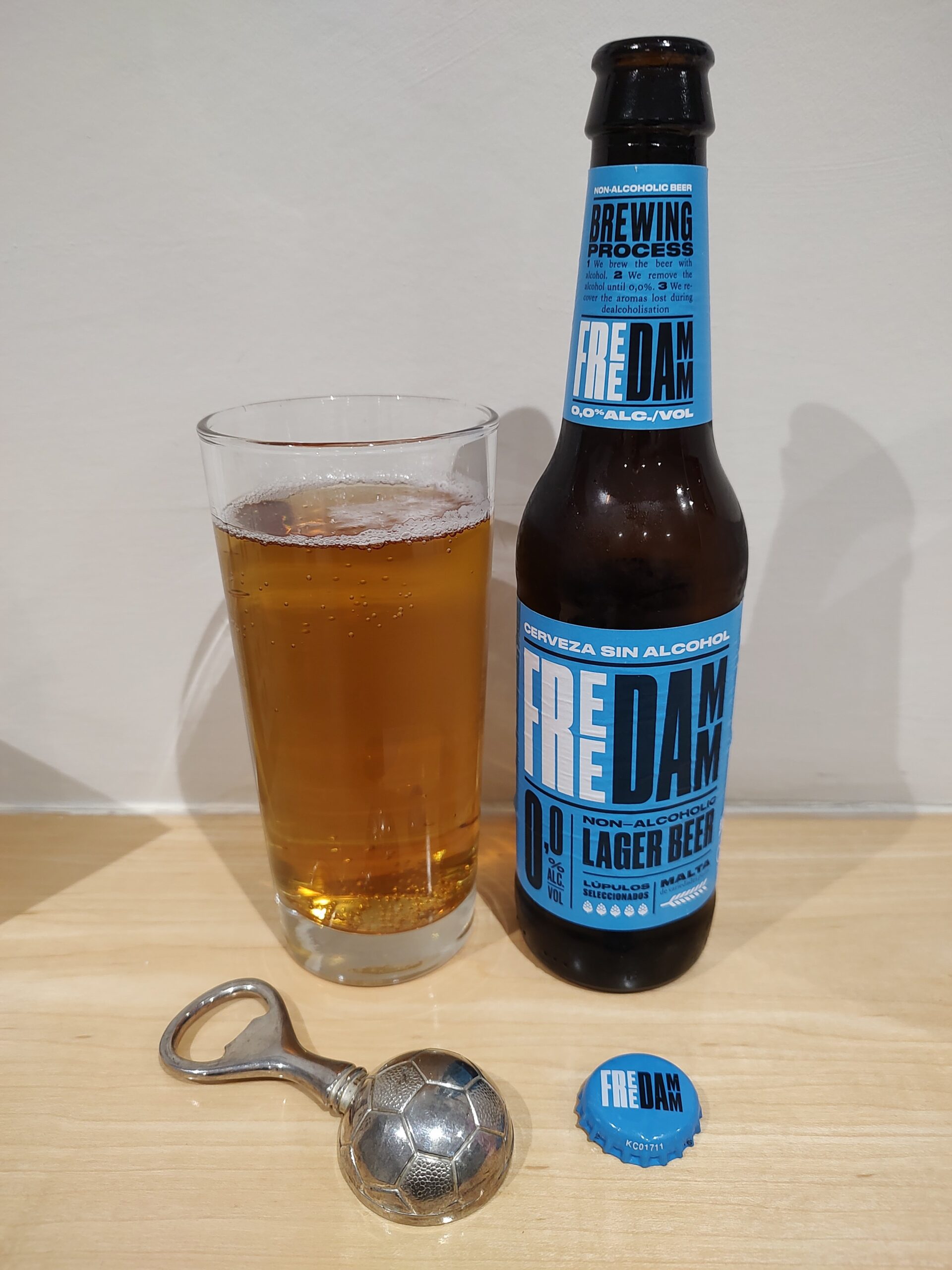
This nicely balanced 0.0% lager from The Damm brewery in Barcelona, Spain, is described on their website as having “a clean, sparkling, transparent amber colour with shades of gold. It has a light head and lively, fine bubbles”. The Damm brewery is famous for their Estrella Damm lager that is ubiquitous in Catalonia and this alcohol-free version is a worthy companion to it. In fact, it begins life in exactly the same way. They outline the brewing process on the bottle label:
We brew the beer with alcohol.
We remove the alcohol until 0,0%.
We recover the aromas lost during dealcoholisation.
And I think they do a pretty good job of it. It had about the right amount of hops and bitterness for my taste and wasn’t too gassy. I’ll definitely be ordering it again and, as a bonus for some people, it’s gluten free and vegan.
Score: 82% Ingredients: Water, barley malt, maize, glucose and fructose syrup, rice, hops. Calories: 20 kcal per 100ml Price: £4.00 for 4x330ml bottles (Tesco, 17/11/2023)
Lucky Saint
Lucky Saint beer
This is a 0.5% alcohol, unfiltered, pilsner style lager that is brewed in Germany for Not Another Beer Co Ltd. The blurb on the bottle describes it as ‘biscuity malts’ with a ‘smooth citrus hop finish’. It’s light in colour and not overly effervescent, but does have a small head on pouring.
I found it to be amongst my favourite low-alcohol lagers. It’s refreshing and went well with my curry, as all good lagers should do. I would definitely consider buying it again.
Score: 82% Ingredients: Water, Barley, Yeast, Hops Calories: 16 kcal per 100ml Price: £1.50 for 1 330ml bottle (Tesco, 14/12/2020)
Brewdog Punk AF
Brewdog Punk AF
This is Scottish company Brewdog’s alcohol free version of their Punk IPA beverage. Like most Brewdog beers, it’s full of flavour and is enjoyable to drink. There’s a good balance of flavours to this one, with tropical fruits in evidence and competing for attention with what they describe as ‘grassy and pine notes’. It’s every bit as tasty as the original alcoholic version and I’d happily make it one of my regular choices. It’s not overly fizzy either, and is fairly light on the calories, so it has a lot going for it in my opinion.
To me, this tastes more or less how I would expect a half-decent lager to taste, and I even prefer it to the alcoholic version of Heineken. It’s crisp, refreshing, and not overly fizzy. It’s not that dissimilar to the Peroni version, but slightly less fruity and considerably cheaper. I’ll definitely be buying Heineken 0,0 again.
Score: 80% Ingredients: Water, Malted Barley, Hop Extract, Natural Flavourings Calories: 21 kcal per 100ml Price: £4.50 for 6x330ml cans (Tesco, 21/07/2020)
Nanny State
Brewdog Nanny State ale
If you prefer an ale to a lager, which I often do, then Brewdog’s Nanny State is a good option. It has all the flavour of many of their regular ales whilst coming in at less than 0.5% ABV, which qualifies it as ‘alcohol-free’ under UK legislation. It’s bitter and hoppy with a medium-dark amber hue and I really like the taste. Also counting in it’s favour is the extremely low calorie count, so it won’t damage your waistline.
Leffe is a venerable Belgian brewing brand and I’ve always liked their alcoholic range of beers so I had high expectations of their entry into the non-alcoholic end of the market. However, I didn’t feel that this one quite comes up to the standard set by their other offerings.
It was nice enough, and not too fizzy, making it perfectly drinkable, but the flavour wasn’t quite to my taste. The label promises ‘subtle notes of vanilla and cloves’, but try as I might, I couldn’t pick out either of them. Perhaps my palate just isn’t refined enough.
It’s not unreasonably priced, although I’m not particularly fond of the 250ml bottle size as it doesn’t make for a very substantial drink. What it lacks in volume, it makes up for in calorific content. With a count of 40 kcal/100ml it’s 50% higher than most of its rivals and more than double many of them.
Score: 79% Ingredients: Water, Barley Malt, Maize, Barley, Sugar, Hops, Natural Aromas. Calories: 40 kcal per 100ml Price: £4.50 for 6 x 250ml bottles (Tesco, 28/02/2021)
Doom Bar Zero
Doom Bar zero
Sharp’s Brewery from Rock in Cornwall have produced an alcohol free version of their popular Doom Bar amber ale.
They describe the aroma as spicy resinous hop and sweet roasted malts, and the taste is said to be succulent dried fruit and lightly toasted malts.
It has a very low calorie count and is decent value for money. I liked it, but not quite as much as I liked the Nanny State ale above, hence the slightly lower score.
Score: 78% Ingredients: Water, Malted Barley, Sugar, Oats, Hops & Hop Extracts, Antioxidant: Ascorbic Acid, Natural Flavours. Calories: 13 kcal per 100ml Price: £1.30 for 1 x 500ml bottle (Tesco, 18/09/2020)
Innis & Gunn
Innis & Gunn 0.0% lager
Innis & Gunn is an Edinburgh based brewer that was founded in 2003 and whose beverages have become increasingly popular across Scotland over the past couple of decades. Their regular lager product is usually 4.6% ABV but they now offer an alcohol-free version that’s made with a special yeast strain that doesn’t produce alcohol.
This lager is brewed with golden oats, which apparently contribute to a smooth finish, and it is described on the can as crisp, zesty and refreshing. It certainly packs a lot more flavour than most lagers and I did find it fairly smooth on the palate. It’s another one that I’d happily drink again.
Score: 78% Ingredients: Water, Barley, Oats, Hops. Calories: 23 kcal per 100ml Price: £5.00 for 4 x 440ml cans (Tesco, 04/06/2022)
St Peter’s Without
St Peter’s Without beer
This is the first non-alcoholic beer that I have tried without having ever previously tasted one of the brewer’s alcoholic beverages. I was unfamiliar with the St Peter’s brewery from Suffolk until I saw this intriguingly shaped 500ml bottle on the shelves of Tesco.
This 0.0%, full bodied, dark amber ale comes in a vessel that has the appearance of an old fashioned medicine bottle, but the taste is far from medicinal. It describes itself as ‘rich and malty’, ending with a ‘delicate bitterness’ and that proved to be an accurate claim.
It took a while to grow on me, as the first few mouthfuls did seem overly bitter for my taste, but by the end of the bottle my palate was signalling its approval. It’s definitely one of the most flavoursome alcohol-free brews that I have tried and I’ll be coming back for more.
Score: 77% Ingredients: Water, Malted Barley, Rye, Hops, Yeast Calories: 29 kcal per 100ml Price: £1.30 for 1 x 500ml bottles (Tesco, 08/10/2020)
Corona Cero
Corona Cero beer
This was a refreshing but fairly bland lager. I imagine it’s nice to drink in the sun on a hot day, but it didn’t really stimulate my taste buds very much. I don’t think it’s quite as flavoursome as the alcoholic version of Corona. Perhaps, like its alcoholic cousin, it could benefit from a slice of lime to enhance its citrus kick, but I opted to drink it without in order to sample its unadulterated taste.
In its favour are that at only 17 kcal per 100ml it’s not going to harm your waistline, and it’s not too fizzy, so it slips down easily. Nonetheless, I don’t think I’ll be rushing back to it unless it’s on special offer.
Score: 77% Ingredients: Water, Barley, Malt, Maize, Sugar, Hops, Natural Flavours Calories: 17 kcal per 100ml Price: £4.00 for 4 x 330ml bottles (Tesco, 23/02/2022)
Adnams Ghost Ship
Adnams Ghost Ship beer
The Adnams brewery from Southwold in Suffolk produces this low-alcohol version of their Ghost Ship citrus pale ale, which registers at 0.5% ABV rather than the 4.5% of the standard version. The 0.5% brew actually starts life as the standard version but they then use a ‘de-alcoholiser’ to remove most of the alcohol and leave a drink that tastes the same but will keep you sober.
I liked it and found it to be just as full of flavour as the brewery suggests, although the citrus kick was slightly too pronounced for my taste, so I haven’t scored it quite as highly as some of the other ales here. It’s definitely very drinkable though.
Score: 76% Ingredients: Water, Malted Barley, Malted Rye, Hops, Yeast. Calories: 23 kcal per 100ml Price: £1.30 for 1 x 500ml bottle (Tesco, 18/09/2020)
Guinness
Alcohol Free Guinness
This has to be one of the alcohol-free beers that is most faithful to the taste of its alcoholic cousin. It’s a while since I’ve had a pint of the original Guinness, but this zero alcohol version smelled and tasted almost exactly how I remembered a pint of Dublin’s most famous export to taste. I’m not sure that I would have known the difference if it had been a blind test. The colour, look and feel in the mouth are also practically indistinguishable from the real thing.
They say that the brewing process starts in exactly the same way as for the alcoholic version, but the alcohol is then removed via a cold filtration method, so all the flavour remains and it is essentially the same drink minus the alcohol. Top marks for authenticity then. If you’re a Guinness drinker then you should like it. Personally, it’s not my favourite tipple, which is why it’s not quite up there with my highest scoring alcohol-free beers, but I do enjoy a stout from time to time and I’ll probably return to it occasionally.
The cans contain a ‘widget’, or nitrogen filled capsule that ‘surges with bubbles when the ring pull is opened’, which simulates the pouring of a beer on draught and helps deliver the ‘smooth, velvety texture’ and creamy head that you get from a pint of Guinness on tap.
Score: 74% Ingredients: Water, Malt, Barley, Roast Barley, Fructose, Natural Flavourings, Nitrogen, Hops. Calories: 17 kcal per 100ml Price: £4.00 for 4 x 440ml cabs (Tesco, 01/06/2022)
A Ship Full of IPA
A Full Ship of IPA beer
This is another offering from the Brutal Brewing company based in Vårby, Sweden, which also produces the Pistonhead lager featured above. It’s a 0.0% alcohol India Pale Ale that sometimes pops up in my local supermarket.
I liked it, although it was probably slightly too bitter for my taste, so it’s not quite up there amongst my favourite alcohol-free ales.
Score: 72% Ingredients: Water, Barley, Malt, Hops. Calories: 20 kcal per 100ml Price: £1.50 for 1 x 330ml bottle (Tesco, 08/11/2020)
Bavaria
Bavaria 0.0% beer
Despite the name, Bavaria is a Dutch brand and has been brewing beers under that label for almost a century, with non-alcoholic varieties for over 40 years. I was unsure about this one at first, but it gradually grew on me over time. It has a smooth, slightly viscous feel on the palate and is not too effervescent, leaving behind a mildly sweet aftertaste. It’s nothing special, but it’s perfectly drinkable and its main competitive advantage is its price. Coming in considerably cheaper than most of its rivals, it’s a good option if you’re looking for a cheap night and value for money.
Score: 72% Ingredients: Natural Mineral Water, Barley Malt, Wheat, Hops Calories: 24 kcal per 100ml Price: £4.00 for 8x330ml cans (Tesco, 06/07/2020)
San Miguel 0,0
San Miguel 0,0%
On first taste my initial reaction wasn’t particularly positive, although it did grow on me as I drank more. It feels a bit heavier than some of the other offerings here, with more depth of flavour and has a slightly amber hue. It doesn’t seem as refreshing as some of the others, and it wouldn’t be my go-to choice to cool down on a sunny afternoon. Maybe it’s better suited to a cold winter’s night.
Score: 65% Ingredients: Water, Barley Malt, Hops, Flavourings Calories: 24 kcal per 100ml Price: £3.49 for 4x330ml bottles (Tesco, 11/08/2020)
Wheesht
Wheesht 0.0% ale
This is a dark ale from the Harviestoun brewery in Alva, Clackmannanshire, Scotland. The word ‘wheesht’ is Scots slang for telling someone to be quiet, and they’ve certainly muted the alcohol in this 0.0% beverage. The label describes it as having “aromas of roasted chocolate, sweet biscuit and dried fruit” and my nose could pick out the dried fruit at least, if not the other two.
Taste wise, I think it achieves what it sets out to do, so if you like this sort of ruby ale then you’ll probably enjoy a bottle of Wheesht. For me, it’s a bit too far towards the bitter end of the scale for my palate, so I can’t see me drinking it regularly, but I might be partial to the occasional one.
Score: 64% Ingredients: Water, malted barley, malted wheat, malted rye, pinhead oats, malt extract and hops Calories: 16 kcal per 100ml Price: £1.50 for 1x330ml bottle (Sainsbury’s, 02/07/2022)
Tennent’s Zero
Tennent’s Zero lager
Scotland’s best known lager brand has produced their own alcohol-free version and I had the opportunity to assess it first hand whilst knocking back a few cans in the sun at a Queen’s Platinum Jubilee community picnic event in 2022. It went down well enough in the convivial summer party atmosphere, but then pretty much any cool drink would.
Overall, I’d say it’s rather average fayre. Nothing much to write home about. I’m placing it in the lower-mid-table section of my ranking as it’s a fairly bland and unremarkable drink. I was never particularly fond of the alcoholic version of Tennent’s compared to the plethora of alternatives available, and this ‘zero’ version probably occupies a similar market position in my mind. I doubt I’ll be rushing back to it.
Score: 59% Ingredients: Water, Malted Barley, Hop extract Calories: 17 kcal per 100ml Price: £3.75 for 4x440ml cans (Sainsbury’s, 15/06/2022)
Budweiser Zero
Budweiser Zero
I found Budweiser’s zero alcohol offering to be fairly bland when compared to some of the competition, so in that respect it’s a bit like their standard alcoholic version. There’s not much substance to it and it’s a bit too carbonated for my liking. The low calorie count means you can drink a few of them without piling on too much weight, but that’s about all it has in its favour.
The first two times I tried to buy Stella Artois’ alcohol free lager in my supermarket home delivery order, it failed to turn up, which suggests it’s either extremely popular and sells out quickly or there are supply chain issues. It was third time lucky and by then I was eagerly anticipating my first taste of Stella’s entry into this market. However, I was disappointed as it failed to live up to my expectations.
It’s heavily carbonated and simply too gassy for my liking. So much so that I couldn’t drink it regularly. It tastes not unlike the standard version of Stella, and is not the worst offering out there, but it doesn’t stand up to comparisons with my favourite non-alcoholic lagers and I doubt I’ll be buying it again, especially as it’s slightly more expensive that some of the competition.
Beck’s Blue is one of the most widely available alcohol-free beers in shops and bars in the UK and has been one of the market leaders for a while now, but I personally don’t particularly like the taste of it. It’s far more bitter than most of its competitors and leaves a strong after taste on the palate. I find the occasional one is OK if there’s nothing else on offer, but I wouldn’t want to drink many of them. The low calorie count does mean that it’s not bad for your waistline.
Score: 35% Ingredients: Water, Malted Barley, Hops, Yeast Calories: 14 kcal per 100ml Price: £3.50 for 6x275ml bottles (Tesco, 11/08/2020)
Sainte Etienne
Sainte Etienne beer
This is a typical budget French lager that is exclusive to Aldi. It’s cheap and it tastes cheap. It’s also far too sharply effervescent. I didn’t like it and I’m unlikely to buy it again unless there’s absolutely nothing else available. It also loses points for bearing a name not dissimilar to that of Lyon‘s fiercest rivals!
Score: 21% Ingredients: Water, Barley malt, Hop extract, flavouring, citric acid. Calories: 23 kcal per 100ml Price: £0.89 for 1x500ml bottle (Aldi, 11/12/2020)
Conclusion
As with regular beers, the range of alcohol-free beers varies greatly in quality, although this is very much subjective to individual taste and preference. However, there is now a wide enough selection of products available that most people could probably find one that meets their approval. Personally I find that my favourite non-alcoholic beers are every bit as good as any alcoholic versions – the only noticeable difference being that they don’t get you drunk.
Therefore, it seems to me that the only remaining reason for drinking alcoholic beer is if you’re drinking specifically to get drunk. If you’re just having one or two beers in an evening then you wouldn’t be getting drunk anyway so you might as well stick to the healthier, non-alcoholic option. Given the recent studies that have concluded there is no safe level of alcohol to have in your diet, I’m happy to convert to alcohol-free beer for the foreseeable future and limit my alcohol intake to the occasional wine or whisky until they develop alcohol-free versions of wines and spirits that are as good a the real thing.
Lyon qualified for the Quarter-Finals of the UEFA Champions League courtesy of a tense Friday night 2-1 defeat away to Juventus in Italy. The loan goal of the first leg scored over four months earlier by the now departed Lucas Tousart, combined with the clean sheet at home gave Lyon the platform for a defensive, counter-attacking performance in Turin that led to an unlikely upset for the Italian champions.
Lyon knew that if they could score in the Juventus Stadium then the hosts would need three, and that’s exactly what happened in the twelfth minute when Houssem Aouar went down inside the Juve box to earn a somewhat dubious penalty. Memphis Depay converted it with a beautifully executed ‘panenka’, having sent goalkeeper Wojciech Szczesny the wrong way, to give Lyon a dream start.
The visitors’ attention then turned to defending as Juventus began to pile on the pressure. Anthony Lopes was again on form in the Lyon goal, although he was rounded once by Bernardeschi who looked certain to score until a superb last ditch intervention from Marcelo saved the day. Ronaldo spurned a couple of free kick opportunities before allowing Lyon old-boy Miralem Pjanic the chance to take one just before half time.
The Bosnian fired in an effort that brushed the end of the Lyon wall where Depay was trying to get out of the way. If there was any contact with Depay’s are it was minimal and entirely unavoidable but incredibly the referee and VAR officials decided to award Juventus one of the most ridiculous penalties you are ever likely to see given. Ronaldo made no mistake from the spot to level the scores.
The second half was largely one way traffic with Juventus trying to find a way through the disciplined defensive unit in front of them. They managed to do so on the hour mark when Cristiano Ronaldo found enough space on the edge of the Lyon box to fire a vicious shot past his compatriot Lopes and leave Lyon’s aggregate lead hanging by a thread.
The last thirty minutes plus six minutes of additional time seemed to last an eternity for Lyon supporters but the team held out resolutely, surviving a few close calls, notably a Ronaldo header that probably should have been scored. The introduction of Paulo Dybala looked ominous for Lyon, but the Argentinian striker was not fully recovered from an injury and limped off a few minutes later, his departure further dampening the spirit of the Italian side.
Lyon managed to break out of their own half and carry the ball towards the opposition corner flags a few times in the the closing minutes, using up valuable times and eventually clung on to progress to the quarter-finals by the narrowest of margins. Manchester City await them in Lisbon on Saturday.
Moussa Dembélé was born and grew up in Pontoise, just to the north of Paris, and as a schoolboy footballer he attracted the attention of scouts from Paris-Saint Germain, who brought him into their youth system at the age of eight.
Dembélé progressed steadily through the junior ranks at PSG until the club’s 2011 purchase by Qatar Sports Investments transformed them overnight into a financial behemoth with the power to buy their way to success. Seeing his path to the first team potentially blocked by galactico arrivals, he moved to Fulham a year later, aged just sixteen.
He initially continued his development in the Fulham youth teams and made his debut as a substitute in November 2013 aged seventeen. A spattering of appearances followed over the course of the next eighteen months before his breakthrough season in 2016-16 saw him become a regular and plunder 15 goals in the Championship.
In June 2016 he moved north of the border to Celtic, where he quickly established himself as a key part of their front line. Over the course of the following two seasons he scored 51 goals for the hoops in all competitions, won the treble twice, made the Premiership Team of the Year and got his first taste of Champions League action.
By now he was also scoring regularly for the French Under-21 team and was attracting attention across Europe. A couple of days after selling Mariano Diaz to Real Madrid in August 2018, Lyon moved to sign Dembélé as a direct replacement for their departing striker for a fee reportedly rising to €22 million.
Dembélé’s first season in the Rhône department brought a return of fifteen league goals, plus a further five in cup competitions as he adapted to the step up in level. He had already beaten those goal tallies in the 2019-20 season, his second at the club, when the Covid-19 pandemic brought an abrupt end to proceedings.
Aged 24 at the time of writing, Dembélé is still developing as a striker and there’s plenty of room for improvement to his all-round game. His finishing is a strong point, although he often needs a sighter to find his range in a match, rarely seeming to find the net with his first chance of a game.
He has at times been deployed as a loan front man by Lyon and I don’t feel that the role suits him well. He’s not great at holding the ball up until team mates arrive, and plays much better when there’s an additional forward or two in close support. He also needs to improve his interplay with his colleagues and get a few more assists.
However, his goal return is undeniably good and if it continues to improve on the current trajectory as he approaches his peak years then he’ll soon outgrow Lyon and find himself on the shopping list of Europe’s elite clubs with a hefty price tag. Lyon may even have signed Karl Toko Ekambi on a permanent deal in summer 2020 as a potential replacement for Dembélé with a view to cashing in on him sooner rather than later.
Date of Birth: 12/07/1996 Place of Birth: Pontoise Nationality: French Joined OL: 31/08/2018
Olympique Lyonnais lost out on penalties to Paris-Saint Germain in the last ever Coupe de la Ligue final after holding the champions to a goalless draw at the conclusion of extra time. It was a spirited performance from Lyon and they matched PSG for long periods of the game at the Stade de France, even having some chances to win the match, but in the end their penalty shoot-out jinx came back to haunt them.
The first five penalties for each team were converted before Bertrand Traoré’s spot kick was saved by Keylor Navas and Pablo Sarabia stepped up to fire past Anthony Lopes and clinch the trophy for PSG. Lyon now have the undesirable record of having lost 16 of the 20 penalty shoot-outs they have contested in domestic cup competitions.
Maybe things would have been different if Ciprian Tătărușanu had been available. The Romanian goalkeeper had been playing in Lyon’s run to the final of the Coupe de la Ligue and had saved a penalty in a rare shoot-out win against Lille in the semi-final, but he injured himself in the run up to the final and didn’t even make the bench.
Regular first choice goalkeeper Anthony Lopes put in a sublime performance during the 120 minutes of play and was possibly Lyon’s best player on the day, but he never looked like saving any of the PSG penalties. He may well be one of the best ‘keepers in the country, perhaps even in Europe, but penalty saving is not his forte. He doesn’t seem to be imposing enough to disconcert opposition penalty takers, and he tends to dive early giving them the chance to place the ball on the other side of the goal. Perhaps the greater height and stature of Tătărușanu would have unnerved some of PSG’s penalty takers enough to force a mistake.
The first period of normal time had been a fairly cagey affair. The opening exchanges were very even with both sides gently probing each other in midfield and taking time to settle into the game. There was a shot from Neymar that flew not far past the far post and a half chance for Memphis Depay at the other end and Lyon enjoyed plenty of possession without creating many openings.
The only booking of the first half came in the nineteenth minute when Maxence Caqueret was cautioned for a foul on Neymar, but that aside it wasn’t a particularly physical encounter. There was nothing to choose between the sides at the drinks break but Matteo Veratti began to impose himself on the game thereafter, pulling the strings imperiously from midfield.
Lyon forged an opportunity in the 37th minute when a cross from Depay forced Thiago Silva into conceding a corner from which Cornet had a chance but couldn’t get enough behind his shot. The game opened up in the last five minutes of the first half. First there was a Neymar chance in the 40th minute but he shot wide when put through down the left. Then a long-range effort from Idrissa Gueye produced a save from Lopes. Next Aouar spurned a great chance for Lyon with an air shot and PSG broke immediately but Di Maria fluffed his shot at the other end of the pitch.
The second half largely followed the pattern of the first, with both teams creating occasional chances, PSG doing so a bit more frequently than Lyon, although neither side produced any gilt edged opportunities that you would say they absolutely should have scored from.
The half was also punctuated by substitutions as the players tired from a lack of match fitness following the long break due to the Covid-19 lock down. Lyon withdrew Bruno Guimaraes first, shortly after he was booked for persistent fouling, to be replaced by Thiago Mendes. Their goal threat was reduced somewhat when both Memphis Depay and Moussa Dembele were replaced in the 80th minute by Ekambi and Traoré, and Marcelo limped off to be replaced by Andersen a minute later.
Leo Dubois was another casualty when he picked up a knock in the final five minutes of normal time and had to give way to hapless Brazilian fullback Rafael. Rafael picked up his customary red card in the final minute of extra time when he brought down Di Maria just outside the box. Neymar failed to convert the free-kick and the referee signalled full time and a penalty shoot-out, which took place at the end occupied by the PSG fans.
Houssem Aouar is a product of Olympique Lyonnais’ successful youth system that seems to churn out no end of exciting young talent, especially in the technically adept midfielder mould of which this Frenchman of Algerian descent is a prime example.
Aouar was born and raised in Lyon and joined the club as an eleven-year-old in 2009. Eleven years down the line, having spent over half his lifetime on the club’s books, he has established himself as one of the team’s most prized assets and has reportedly caught the eye of scouts from some of Europe’s top clubs.
He can play in a number of positions across the midfield, but is probably best suited to a central role. He’s blessed with a good first touch and is comfortable on the ball and running at opponents. He’s something of an all-rounder with an engine to get up and down the pitch between the boxes, but on balance his game tends to be much more attacking than defensive.
If there was one glaring area for improvement in his game over the past couple of seasons since he became a first team regular in the 2017-18 campaign it has been his end product in the final third. All too often he would make the wrong decisions when in a good position in or around the opposition penalty area and would waste possession in a promising situation.
He seemingly had far too great a confidence in his own shooting ability and would often shoot from range, failing to trouble the goalkeeper, when teammates were available in better positions. Be it poor decision making, or simply a lack of vision and awareness on the pitch, it’s a trait common to many young players and one that often diminishes as they gain experience.
He has worked hard at this aspect of his game over the past season and has finally started to find the net a bit more regularly, scoring nine times in thirty-seven appearances in the the 2019-20 season before the Covid-19 pandemic and producing some crucial goals in big matches. His performances have gone a long way towards filling the gap left in the Lyon midfield when Nabil Fekir left for Betis in summer 2019 and he has started to become a leader on the pitch in his own right.
Aouar has represented France at under 17 and under 21 levels and if he continues to rise on his current trajectory then it may not be long until he gets a call-up to the full French squad. It remains to be seen whether he will continue his development at his home town club or whether Lyon president Jean-Michel Aulas will choose to cash in on another of his bright young stars and accept an offer from one of his many suitors.
Date of Birth: 30/06/1998 Place of Birth: Lyon Nationality: French Joined OL: 2009